

Wall Street, high-pressure trading floors, multi-million-pound bonuses, and the success stories of young traders who made their fortunes within a few years. For decades, the role of a trader has captured the imagination and continues to attract a great many candidates.
The reality, however, is very different from the image portrayed by films or social media. Behind the screens and charts lies, above all, a demanding profession in which risk management, analysis and discipline matter far more than intuition or the pursuit of quick profits.
Although traders still occupy a central place in the financial markets, the paths into this profession have changed considerably. Opportunities are no longer limited to the trading floors of major banks, and the skills sought today are sometimes very different from those valued twenty years ago.
📌 What this article covers
In this guide, we look at what the job of a trader really involves, the different career paths available, the most relevant courses of study, the most sought-after skills, as well as the alternatives for those who want to trade independently.
Also worth reading: Scalping, day trading or swing trading: which trading style should you choose?
What is a trader?
A trader is someone who buys and sells financial assets with the aim of generating returns or carrying out transactions on behalf of an institution. That definition may sound simple, but in reality it covers a wide range of very different roles.
Some traders work within major investment banks and operate in the markets on behalf of institutional clients. Others work in asset management firms, hedge funds or quantitative funds. And some choose to manage their own capital entirely independently.
Contrary to a widely held belief, a trader's job is not to predict the markets with certainty. Professionals think more in terms of probabilities, scenarios and risk management.
The objective is not to be right on every trade, but to make sound decisions consistently over the long term while keeping potential losses under control. This is probably the most misunderstood aspect of the profession.
A profession that has changed dramatically
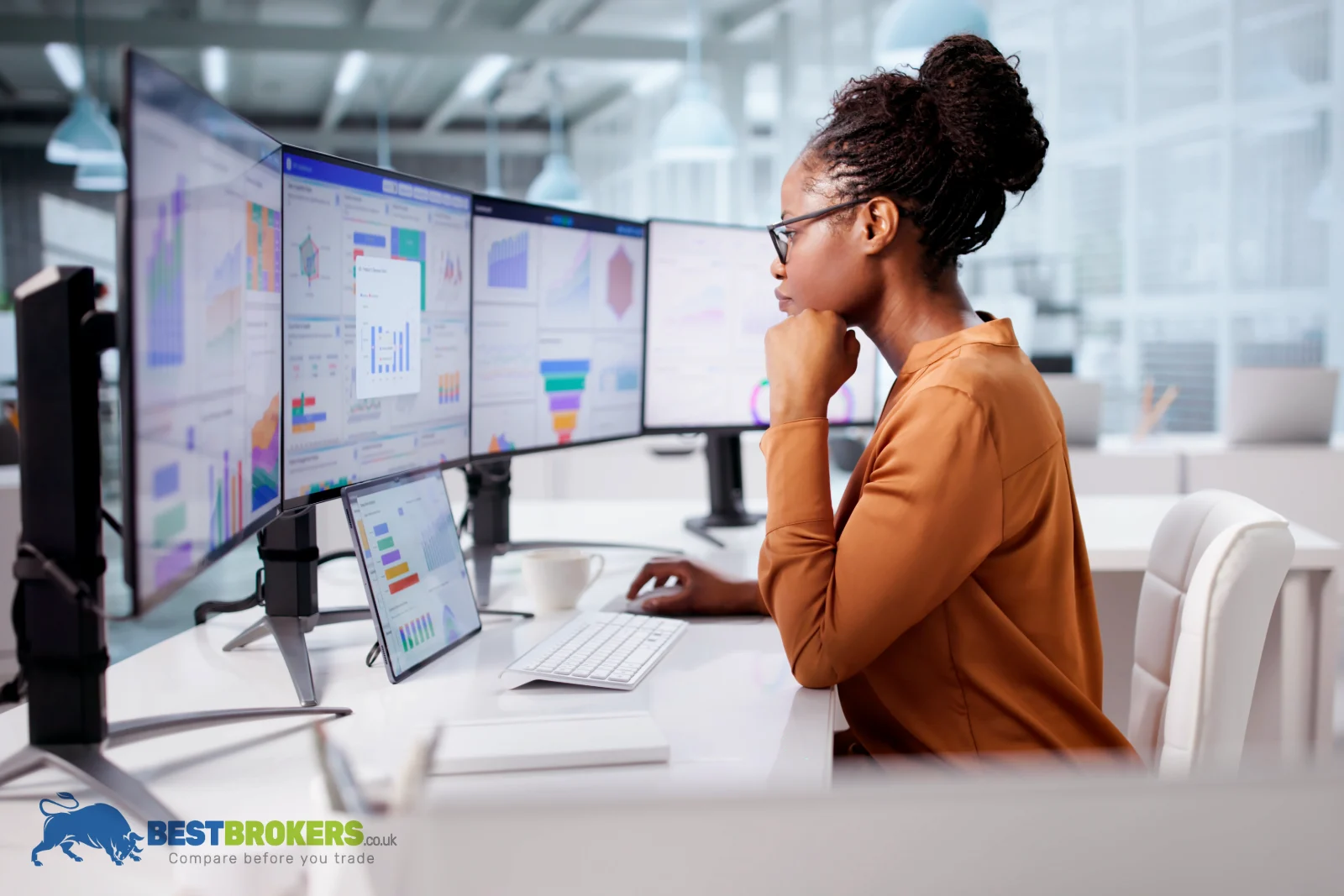
When people think about trading, many still picture the trading floors of the 1990s or 2000s, filled with dealers placing orders over the phone... Today's reality is far more technological.
Automation has transformed a significant part of the financial industry. Algorithms now play a major role in market activity, and technical skills have become essential in many positions.
This shift has also changed the profiles firms are looking for. Banks and funds are still interested in candidates with a strong grounding in finance, but they are now placing increasing emphasis on applied mathematics, programming and data analysis.
More than ever, the modern trader must combine financial expertise, quantitative rigour and a strong command of technological tools.
The different types of trader
To speak of the job of a trader as though it were a single profession is, in reality, an oversimplification. Responsibilities vary greatly depending on the environment in which the professional operates.
| 👨💼 Type of trader | 🌍 Organisation | 🎯 Main role |
| Sell-side trader | Investment bank | Provide liquidity and execute transactions |
| Buy-side trader | Asset management firm, fund | Implement investment decisions |
| Quant trader | Quantitative fund | Develop and use statistical models |
| Proprietary trader | Prop firm | Trade the firm's capital |
| Independent trader | Personal account | Manage their own portfolio |
These different categories share a common foundation of skills, but day-to-day responsibilities can differ considerably.
💡 Did you know?
Although all traders operate in the financial markets, their daily work can look very different. A quant trader will often spend more time working on statistical models than following price movements. By contrast, an independent trader will devote a large part of their time to risk management and executing their own strategies.
What does a trader's day-to-day work look like?
Day-to-day reality is generally far less dramatic than the public imagines!
A trading day often begins well before the markets open. Professionals analyse economic news, company results, upcoming data releases, and events likely to influence the financial markets.
Once the markets are open, the work involves monitoring positions, assessing risks, adjusting strategies and reacting to new information.
A large part of the day is devoted to:
- 👉 Analysing financial markets
- 👉 Monitoring and adjusting open positions
- 👉 Assessing risk continuously
- 👉 Using financial data
- 👉 Communicating with other teams
Contrary to popular stereotypes, the most successful traders are not necessarily the ones who take the greatest risks. Very often, they are those who know how to limit their losses and preserve their capital when market conditions turn unfavourable.
Which skills do you need to develop?
Education matters, but it is not enough on its own.
Recruiters are primarily looking for candidates who can operate in an environment where decisions must be made quickly and uncertainty is constant.
Certain skills consistently appear among financial market professionals:
- ✅ Risk management
- ✅ Statistics and probability
- ✅ Financial literacy
- ✅ A strong command of English
- ✅ Analytical ability
Mathematics obviously remains important, but it is no longer, on its own, a passport to the trading floor. Today, a trader must also understand economic mechanisms, be able to process information quickly, and make rational decisions under pressure.
Added to this is a technological dimension that has become impossible to ignore. Programming, particularly Python, is playing an increasingly important role in market teams. The ability to automate certain analyses or work with databases now represents a clear competitive advantage.
Also worth reading: How to choose a CFD broker suited to your profile?
What should you study to become a trader?

Although there are some unconventional routes, the most sought-after positions remain relatively competitive.
Leading universities with strong quantitative programmes have traditionally been one of the main pathways into trading. Graduates from institutions such as Oxford, Cambridge, Imperial College London, the London School of Economics (LSE) and the University of Warwick are particularly valued for their analytical and quantitative skills.
Business schools and finance-focused programmes also play an important role in recruitment. Many professionals working in market finance have studied economics, finance, mathematics or related disciplines at some of the UK's most respected universities.
Internationally, top US institutions such as MIT, Carnegie Mellon, Columbia University, UC Berkeley and Cornell University are also highly regarded, particularly for quantitative finance and trading-related careers.
University education offers excellent opportunities through degree programmes in mathematics, statistics, econometrics, computer science, economics and finance.
In practice, recruiters generally look for a combination of several elements:
- 🔥 A strong academic background
- 🔥 Relevant internships
- 🔥 A good understanding of the markets
- 🔥 Genuine intellectual curiosity
In the most competitive areas, a degree often helps you secure an interview. After that, it is your skills and personality that make the difference.
Can you become a trader without a prestigious degree?
The answer depends largely on the type of career you are aiming for.
To join a major investment bank or certain hedge funds, qualifications often remain an important selection filter. Competition is fierce, and recruiters naturally use the most highly regarded institutions as an initial screening criterion.
However, things are different in other parts of the industry.
Proprietary trading firms, certain specialist structures and independent trading generally place greater importance on real skills than on academic prestige.
A candidate can stand out in particular by presenting:
- ✅ A documented trading track record
- ✅ Personal projects related to the markets
- ✅ Tools or scripts they have developed themselves
- ✅ High-quality financial analysis
This is, in fact, one of the major changes seen in recent years.
Independent trading: dream or reality?
Access to the financial markets has never been easier. A few clicks are now enough to open an account with a broker and begin trading shares, currencies or derivative contracts.
This accessibility partly explains the sharp rise in the number of private individuals interested in trading.
That said, ease of access should not be confused with ease of success.
Independent trading is a particularly demanding activity. The psychological challenges are often underestimated, and many beginners quickly discover that managing their own money is very different from using a simulator or demo account.
Private traders who progress most quickly generally treat this activity as a genuine profession. This notably involves:
- ✅ A trading journal
- ✅ Strict risk management
- ✅ Regular strategy testing
- ✅ Ongoing training
- ✅ Daily discipline
Success often requires several years of learning, self-questioning and gradual improvement.
How much does a trader earn?
This is probably the question asked most often.
As is often the case in finance, there is no single answer.
Pay depends on the country, the employer, experience, level of responsibility and, of course, the performance achieved.
| 👨💼 Profile | 💵 Indicative annual remuneration |
| Junior trader | €45,000 to €90,000 |
| Experienced trader | €80,000 to €250,000 |
| Quant trader | €100,000 to several hundred thousand euros |
| Desk head | Potentially more |
| Independent trader | Extremely variable |
The gaps are considerable, and individual situations vary greatly.
You should therefore be wary of the spectacular figures regularly highlighted online or on social media. Most professionals see their pay rise gradually as they gain experience.
Is a career in trading right for you?
Trading often attracts people for the wrong reasons.
The prospect of substantial earnings is naturally appealing, but it is generally not enough on its own to build a lasting career in this field.
Professionals who succeed over the long term are often driven by a genuine interest in financial markets, economics, data and decision-making in complex environments.
Professionals who thrive in this career generally enjoy:
- ✅ Analysing complex situations
- ✅ Working with numbers
- ✅ Understanding financial markets
- ✅ Making decisions under pressure
- ✅ Learning continuously
They also accept one fundamental reality: losses are an integral part of the profession.
This ability to deal with uncertainty, regularly challenge one's assumptions and keep improving is probably the best indicator of success in this field.
Should you become a trader today?
Becoming a trader remains an achievable goal, but the profession is far more complex than it may appear at first glance.
Leading schools and specialist training programmes remain preferred routes into the most prestigious positions, but they are no longer the only possible path. The rise of proprietary trading, quantitative finance and technological tools has considerably broadened the opportunities available.
Beyond the degree itself, the qualities that set the best professionals apart remain fairly consistent in the end: rigour, discipline, risk management and the ability to learn.
In a world where no one can predict the future with certainty, these are often the skills that make the difference over the long term.


