

While the European defence sector had already been undergoing major change for several years, recent months have strengthened the view that it could be entering a sustained growth cycle. Military budgets are rising, governments are seeking to reduce strategic dependencies, and technology is reshaping the landscape: drones, cyber security, autonomous systems and "dual-use" technologies, used in both civilian and military applications. In short, European defence is no longer just about tanks and fighter jets, and that is naturally attracting investors' attention.
« Europe must invest more in its security, and do so together, for a stronger European defence. »
But one obvious question remains: is there still time to buy these shares after such strong gains, or are the best opportunities already behind us? After all, a company can be flooded with orders and still be a poor investment if its shares are bought at too high a price. To get a clearer picture, let us first look at the market before moving on to the ten shares and ETFs to watch in 2026.
An expanding market, but still an uncertain one
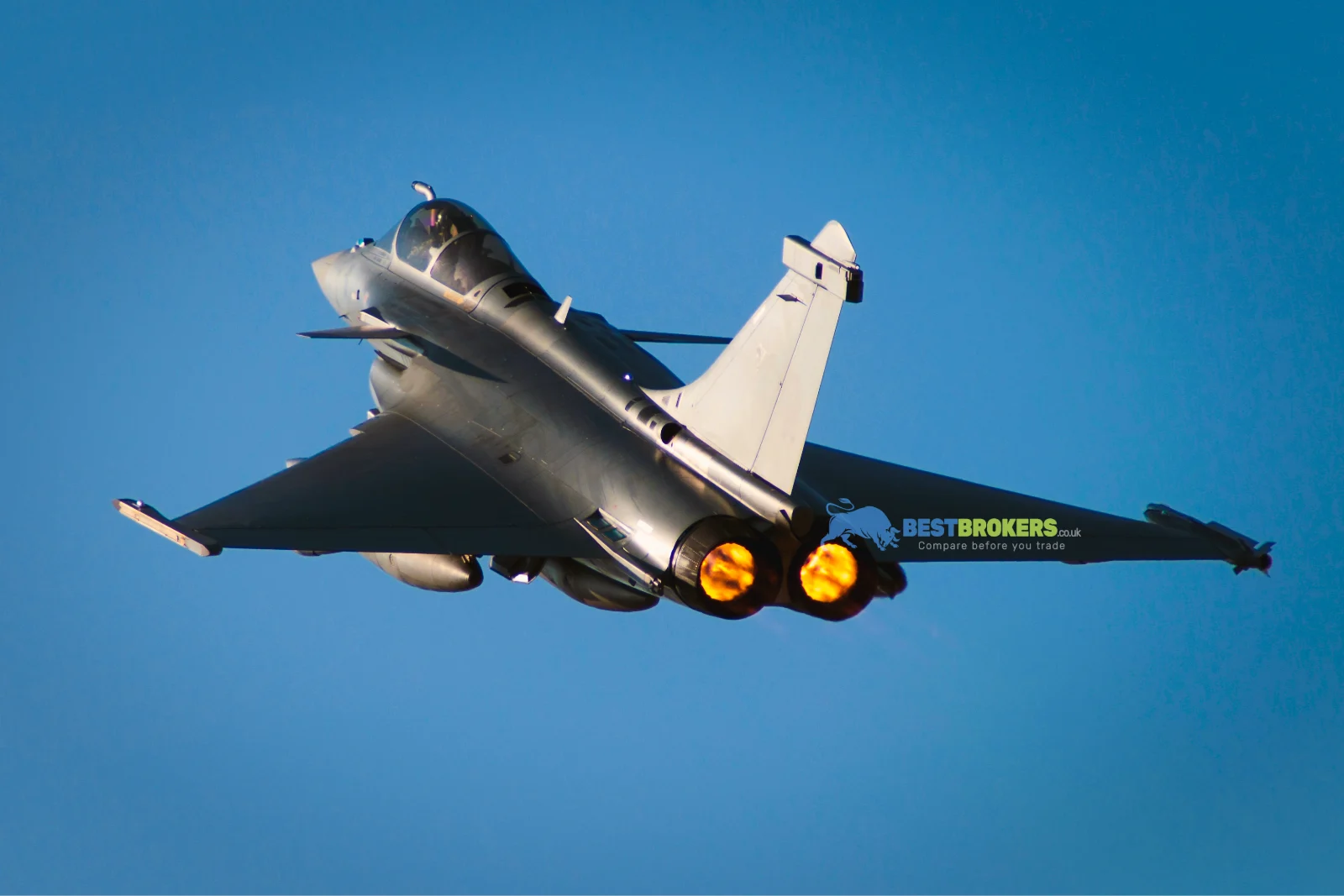
Defence spending is rising sharply
The figures are striking: according to the European Defence Agency, the 27 countries of the European Union spent £360 billion on defence in 2025, up 20% from 2024. The Agency forecasts £391 billion in 2026. These are huge sums, but it is important not to confuse a political target, an approved budget and actual spending. A headline-grabbing announcement does not mean the money has already reached defence contractors.
And above all, where will that money go? Fighter aircraft, ammunition, radar systems, air defence or maintenance? Governments still need to decide their priorities and suppliers, sometimes after lengthy negotiations. That is why higher military spending does not benefit all listed companies immediately, or in the same way.
New orders are finally being signed
Several major names, including Rheinmetall, Thales and BAE Systems, are reporting particularly strong order books. That provides welcome visibility for the years ahead. But an order is not the same as revenue. Imagine a government placing an order today for armoured vehicles to be delivered over five years: the equipment still has to be manufactured, new teams may need to be recruited, and deliveries must then be made on schedule. Revenue is recognised according to the relevant contract rules, not simply on the day the deal is announced. The gap between a signature and financial results can be a long one.
Market uncertainty
Even so, the market does not move in a straight line. Political change, factories struggling to keep up, hard-to-source components or slower-than-expected recruitment can all cool enthusiasm. And "made in Europe" is not automatically the winning option: governments also weigh up price, delivery times and international alliances. Not to mention exports, which can depend on unpredictable diplomatic decisions. None of this cancels out the long-term trend, but it is worth bearing in mind.
That is also why European leaders continue to stress the need to strengthen the continent's defence capabilities, as Emmanuel Macron has done:
« Europe has the economic strength, the power and the talent to rise to the challenge of this era and hold its own against the United States of America, not to mention Russia. We have the means. We must therefore act united as Europeans and determined to protect ourselves. »
Top 10 best European defence shares and ETFs in 2026
#1 - Rheinmetall (Germany)
- ✅ Why back it? Armoured vehicles, artillery, ammunition: Rheinmetall is at the heart of Europe's land rearmament story. And this is no longer just about promises: as of 30 June 2026, the group reported a "Rheinmetall Backlog" of £69.4 billion, covering orders and framework agreements. One caveat: this indicator also includes expected call-offs under framework agreements, so it is not exactly the same as a firm order book. Meeting that demand will still require factories to operate at full capacity.
- ⚠️ Caution: A large part of the good news may already be priced in by investors. Delivery delays, ramp-up difficulties, competition from groups such as KNDS or budget changes could trigger pullbacks, even if business continues to grow.
#2 - Rolls-Royce (United Kingdom)
- ✅ Why back it? Best known for its aircraft engines, Rolls-Royce also plays a strategic role in defence, particularly through propulsion systems for the UK's nuclear submarines. The Unity contract, announced at around £9 billion, highlights this business, which is often less familiar to the wider public. The group also benefits from its civil aviation operations, so it is not a "pure play" defence stock.
- ⚠️ Caution: The company's turnaround and share price recovery have already generated plenty of enthusiasm. Investors need to weigh up the price being paid in the market, the execution of military contracts and the health of the civil aerospace market.
#3 - Thales (France)
- ✅ Why back it? Radar, secure communications, defence electronics, avionics, cyber security: Thales is exposed to equipment that armed forces can hardly do without. People often focus on aircraft and tanks, but without sensors and reliable communications systems, much of their effectiveness is lost. That gives the group exposure to a wide range of needs, across programmes that can run for years.
- ⚠️ Caution: Public-sector contracts can take time both to negotiate and to execute. A programme delay, pressure on margins or industrial difficulties can weigh on results, even when military demand remains strong.
#4 - BAE Systems (United Kingdom)
- ✅ Why back it? BAE Systems is not reliant on a single segment: aerospace, naval platforms, land equipment and electronics, with customers well beyond Europe. Its order backlog, based on its own management indicator, stood at £72.1 billion at the end of 2025. That provides a solid level of visibility, even if those orders do not turn into revenue overnight.
- ⚠️ Caution: Diversification does not mean zero risk. Programme timelines remain complex, and the strong rise already seen in the share price may limit the upside if profits do not increase as quickly as expected.
#5 - Leonardo (Italy)
- ✅ Why back it? Helicopters, avionics, electronics, sensors and defence systems: Leonardo is involved across several parts of the military value chain. Its capabilities in technologies used in both civilian and military markets, together with its role in international programmes, make it one to watch.
- ⚠️ Caution: The group remains sensitive to government decisions, programme schedules and contract profitability. After a strong sector rally, the ability to improve margins sustainably matters just as much as winning new orders.
#6 - Saab (Sweden)
- ✅ Why back it? Saab is best known for the Gripen fighter jet, but also for submarines, radar systems and air defence equipment. With demand rising across the Nordic and Baltic countries, the Swedish group looks well placed to benefit. According to its annual report, its order backlog reached £23.7 billion at the end of 2025. Counter-drone systems are also an area worth following.
- ⚠️ Caution: The shares can be volatile, and certain markets or programmes carry significant weight in its business. In fighter aircraft too, Saab faces powerful competitors. Strong operational growth does not prevent a market correction when expectations run high.
#7 - Safran (France)
- ✅ Why back it? Safran has a distinctive profile: its civil aircraft engines, particularly through CFM International, represent a major part of its business, while its equipment and technologies also serve military programmes. That dual exposure can be an advantage, as growth drivers in civil aerospace and defence do not always move in step.
- ⚠️ Caution: That is precisely why Safran should not be seen as a bet purely tied to rearmament. Air traffic, aircraft production rates, industrial costs and military programmes all influence its results together.
#8 - Kongsberg Gruppen (Norway)
- ✅ Why back it? Less widely covered than some European giants, Kongsberg is well positioned in missiles, maritime systems and certain subsea technologies. With fleets being modernised and coastal protection becoming more important, this specialist could stand to benefit.
- ⚠️ Caution: Dependence on certain large contracts and naval budgets can create uneven performance. Valuation and share liquidity also deserve attention, rather than relying solely on the appeal of its technologies.
#9 - European defence-focused ETFs (e.g. iShares STOXX Europe 600 Aerospace & Defence UCITS ETF, WisdomTree Europe Defence UCITS ETF (WDEF))
- ✅ Why back them? An ETF allows investors to buy a basket of sector-related shares through a single holding. It is a way of avoiding putting the entire investment into one company: bad news for one contractor may be partly offset by other positions in the fund.
- ⚠️ Caution: Diversifying across companies does not remove sector risk. If all defence stocks correct at the same time, the ETF may fall as well. Before choosing, it is worth checking the exact fund names and identifiers, the index tracked, fees, top holdings and the proportion of genuinely European companies.
#10 - Bonus picks: Dassault Aviation and MBDA (via Airbus, BAE or Leonardo)
- ✅ Why back them? Dassault Aviation is benefiting from international interest in the Rafale and from its expertise in combat aircraft. MBDA, meanwhile, is a major missile manufacturer. The two should, however, be distinguished: Dassault Aviation is listed, while MBDA is not directly listed. For indirect exposure to MBDA, investors can look at its industrial shareholders: Airbus, BAE Systems and Leonardo.
- ⚠️ Caution: Rafale contracts depend on negotiations between governments, which are often lengthy and politically sensitive. As for MBDA, buying shares in one of its shareholders is not the same as buying MBDA alone: you are also investing in all the other activities of that group.
💡 Did you know?
An ETF can hold several dozen stocks and still remain concentrated in a handful of large companies. Before investing, look at the weight of its top five holdings: that is sometimes more revealing than simply counting how many companies are in the fund.
Conclusion: enthusiasm that needs to be kept in check
European defence has become a major theme for investors. Rearmament, technological sovereignty and modernisation needs could support defence contractors for years to come. But strong prospects do not guarantee that every stock in the sector is cheap today: the market often prices in good news long before it appears in reported earnings.
Even so, a dose of realism is essential:
- There is still a high degree of uncertainty: budgets, contracts, production capacity and deliveries do not always move at the same pace. It is important to distinguish between promises and orders that are actually executed.
- Beware of "overreactions": a geopolitical announcement can send a share price sharply higher, without future profits changing by the same magnitude. The price you pay still matters.
- Diversification remains an advantage: spreading investments across several companies or using an ETF can reduce stock-specific risk, even if it does not remove the risk shared by the whole sector.
Ultimately, the enthusiasm around European defence is based on solid trends: rearmament, technological sovereignty and equipment needs for the years ahead. The train may not have left the station just yet, but that is no reason to jump aboard at any price. As always in the stock market, what matters most is separating compelling stories from genuinely attractive investments. And for that, nothing beats a little curiosity, patience and selectivity.
Sources: European Defence Agency, Rheinmetall, BAE Systems and Saab (official reports 2025–2026).


